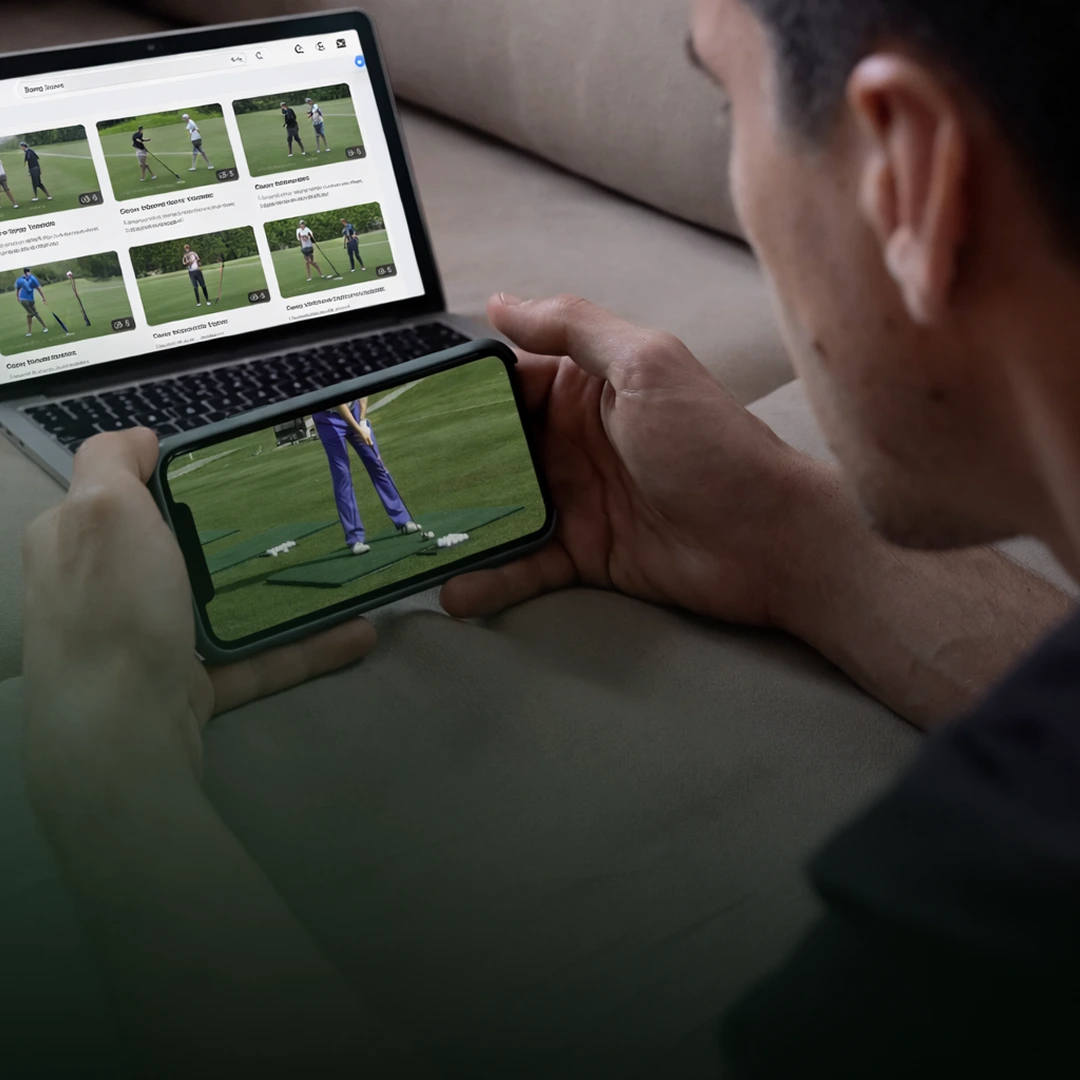
Let us be honest about what winter golf looks like in Ireland. The weather turns. The ground gets heavy. Tee times dry up. Suddenly, your practice routine becomes a warm cup of tea and a late-night scroll through YouTube, convincing yourself that watching golf videos counts as working on your game.
One video promises a quick fix for your slice. The next says the secret is in your wrists. Another swears it is all in the hips. Then someone insists you need to “use the ground”, whatever that means when you are standing on kitchen tiles in your socks.
By the time the season rolls around, you have collected so many swing thoughts that you cannot remember how to hit a normal seven iron. You are not really learning. You are just downloading. That is the trap.
The YouTube Trap: Information Overload
YouTube is brilliant at making golf look simple. A tidy three-minute clip. Clean camera angles. A confident voice saying, “Just do this.”
It feels like progress because it is easy to consume. But watching golf tips is not the same as improving your swing. More often, you are just building a mental pile of instructions with no order, no filter, and no feedback.
That is the hard truth.
- Tips are general. Coaching is specific.
- Tips are entertainment. Coaching is a process.
- Tips are a guess. Coaching is a diagnosis.
Why DIY YouTube Coaching Usually Fails
1. You cannot diagnose yourself properly
Most golfers spend months trying to fix the wrong thing.
You see a ball peeling right, assume you are coming over the top, and start chasing an inside path. You watch a few videos, drop the club behind you, and suddenly you are snapping hooks into the trees. Now you are really stuck.
The video cannot see your swing. It cannot ask what your miss is. It cannot spot what is causing the problem.
A coach can.
2. You are missing the feedback loop
This is one of the most underrated problems in golf.
You try a new move and it feels massive. You are sure you have changed something big. Then somebody records your swing and it looks almost exactly the same as before.
That happens all the time.
Without feedback, you are practising a feeling, not a reality. A coach helps you match what you feel with what is actually happening. That is how real change starts to stick.
3. You are building a Frankenstein swing
One online coach tells you to keep your arms connected. Another tells you to let them swing freely. Both might be right in the right setting, but that does not mean both are right for you.
This is where a lot of golfers get lost. They start stitching bits of advice from different teachers into one swing and end up with something that sort of works on the range, then falls apart as soon as there is pressure on the first tee.
What a Real Lesson Gives You That an Algorithm Won’t
A real lesson cuts through the noise.
Instead of throwing ten ideas at you, a good coach spots the one or two things that are actually driving your bad shots. Instead of assuming your body moves like a tour player’s, they work with your mobility, your habits, and your game as it is right now. Instead of giving you random swing thoughts, they give you a clear plan and a way to practise with purpose.
Most of all, a real coach helps you take changes from the range to the course. That is the bit videos rarely solve.
Choose Coaching Over Collecting
Golf usually improves faster when it gets simpler.
Most players do not need a brand-new swing. They need one clear priority, a better understanding of what is really going wrong, and a bit of proper feedback along the way. They need someone to say, “This is your next step,” and, just as importantly, “Ignore that. It is not your issue.”
That is how you clear the clutter. That is how you stop chasing every tip that pops up on your phone. And that is how you start building a swing you can trust when the wind is blowing sideways on a Saturday morning.
Ready to clear the mental clutter and get your handicap moving in the right direction? Book a golf lesson with a PGA professional and start building a plan that actually works on the course.